Translate

Monday, August 14, 2017

Earthquake at Zion!

The Crack IMG_2803.jpg
The original cement crack - looking north

In 2009 when Benjamin Netanyahu was coming to power in Israel, excavation on the high ridge west of the Gihon Spring revealed a most important artifact.


The Crack 2013-07-24 12.34.28.jpg
After the first few months digging
Permission to excavate began with a crack that threatened a potential landslide. This prompted a rapid approval, so the excavation at Beit Shalem above and west of the high ridge of the Gihon Spring began. Within a few months, the team had made great progress removing rubble below the original crack line.


A 30X8m super-tension retaining wall was built to hold the significant section of Mount Moriah’s eastern slope (below, temple mount seen north). Four years to plan and construct, the wall had to be anchored in bedrock at several points and at each level. Casing each anchor was slow going to avoid penetrating and damaging buried artifacts. Approximately 500 cubic meters of rubble and dirt were ultimately removed for archaeological sifting.


Looking north - Temple Mount seen top left
As the retaining wall descended to 3 meters above the bedrock archaeologists began to discover late iron-age Roman era walls and several pottery artefacts.


Roman era jars and oil lamps found in the top frame of walls that were once rooms - looking west


A collapsed section was well preserved in a narrow passage that had been blocked at its east exit by a ~50cm(w) late iron age (North-South) wall section. At 2m above the bedrock, pottery and other artifacts were found in blackened layer dated to the Babylonian destruction of Jerusalem in 586 BCE. Below the blackened destruction (seen in the image left) layers may yet reveal artifacts that inform about the periods prior.


The video below was made by the Antiquities Authority to describe some of the latest findings.


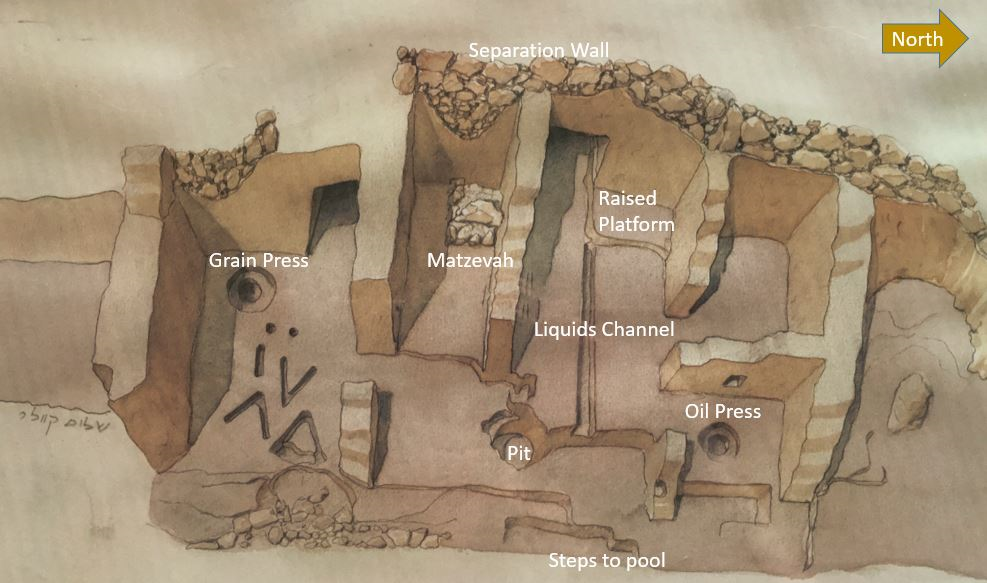
The excavation discussed above, is behind (west) of the western wall of the high ridge, top of image below. Of particular interest on the high ridge is the impressive ‘tziun’, ‘matzevah’, monument or covenant, now protected by the steel cabinet. Archaeologists confirm it was once protected by soft earth contained between the west and a dismantled east wall. Earliest indicators perhaps as far back as 4500 years are hewn directly into the bedrock including cave dwelling, altar, oil and flour presses and facilities for animal slaughter. Sunlight now reaches the bedrock, the first time in ~3000 years.


The matzevah, monument looking west (Separation Wall - see next image)

The bedrock at the western excavation (behind the wall in the image above) descends eastward toward the matzevah dropping by about 1.5m to the bedrock on the high ridge complex (seen below). The complex was hewn using basic rock implements. The volume of this ~4x8x2(h) meter complex is significant. All walls of the rooms were retained from the bedrock.


According to Biblical dating matzevot were last used at the time of Abraham, Isaac and Jacob. Here placement on the hewn bedrock floor provides some important dating targets to around ~2000 BCE, pre-dating King David by 1000 years.


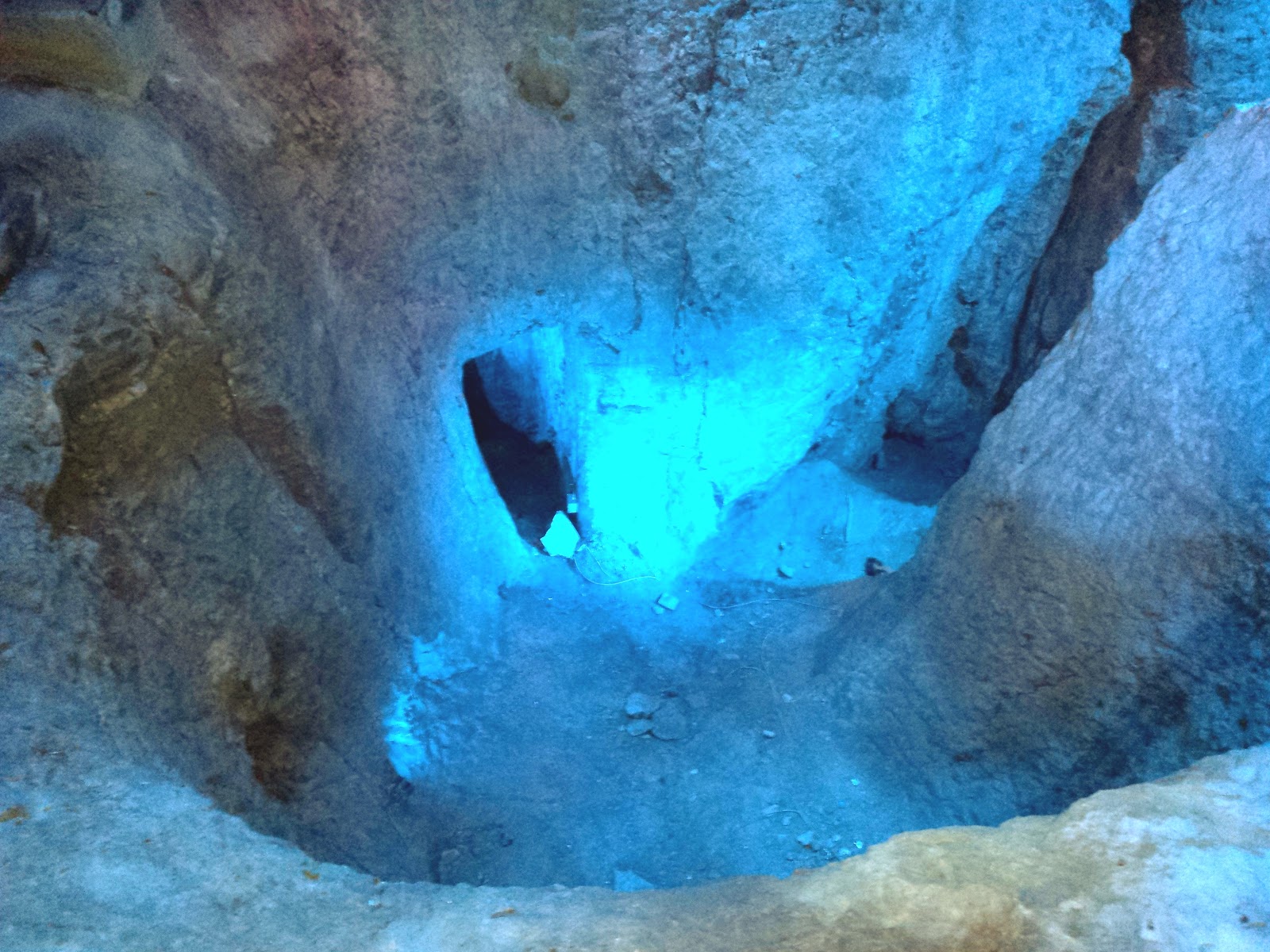
Immediately east of the high ridge as it descends toward the valley is the rock cut pool leading from the Gihon Spring. Large volumes of fish-bones, bones of kosher animals and pictographic bullae were discovered in its lowest levels.
Upper Gihon Pool.jpg
Rock cut pool - looking north


Pictographic seals discovered in the sediment of the rock cut pool equate in vloume to all the other non-pictographic seals discovered elsewhere in the City of David. Perhaps indicating something akin to important people throwing pennies in a pond or leaving notes in a wall. This raises questions about the dating of seals (bullae) that were contained to the pool compared to those of the period of kings.


The Matzevah in context of the City of David on Mount Moriah is a significant archaeological event. If academic analysis supports that hewn bedrock coincides with biblical Shem then the Matzevah is likely to converge with dating for the story of Jacob (Genesis 28:10-22). This would further validate the high ridge to Isaac and Abraham, when it became known as “the Place” (Ha Makom). As such it will have significant implications for theological and religious interpretation of events relative to first temple construction and third temple location.

Tuesday, August 1, 2017

Toward a King!

Tisha B'Av meets Tu B'Av 

Jonathan, the grandson of Moses is one of Tanach’s most complex characters. Perhaps in the tradition of first born sons, we can expect Jonathan's connection with his grandfather to reflect in him the essential traits that we know of Moses.

So what are the qualities of Moses that Jonathan carried into the next generation? What, of his grandfather's causes inspired him to struggle for and express in his own life? Tribal structure is a rigid mosaic that strongly influences personalities, against this backdrop I explore Jonathan.

The information I used to write this is from and based on the compilation known as Me’Am Lo’ez as translated by Rabbi Aryeh Kaplan. It is an amalgamation of references including Tanach, Midrash and Gemara that allows these time bound events to be connected.

After Israel’s re-entry to their land each tribe conquered and settled their allotment except one. For the last tribe Dan military support from the other tribes had dissipated. Tribe Dan was left to struggle for its allotted land against the mighty Philistines, arguably Israel’s greatest opponent as a result tribe Dan failed in their quest.

At the time, Jonathan a Levite priest had distanced himself from the insular and decaying priesthood at the Tabernacle of Shiloh in the territory of Joseph's son Ephraim. Nearby, at a competing temple of idolatry Micah, its founder enlisted Jonathan as high priest.

Without their land and only trivial support from the rest of Israel's tribes, breakaway leaders of Dan moved to conquer and settle land in Israel's extreme north. Disappointed with their tribal brothers, on one trip Dan's leaders forcefully raised Micah's temple and moved it, with Jonathan to the mountain directly opposite the valley of the tabernacle in Shiloh. Perhaps a statement to the other tribes who had not fully supported them in their original conquest.

On one occasion Jonathan, the Levite priest and his concubine companion were traveling from south to north, from Bethlehem in Yehudah through Jerusalem (Jebus) to the area of Shiloh in Ephraim. It was nearing sunset, but Jonathan pushed on past Jebus, the fortified city until he reached Gibeah in Benjamin a territory sandwiched between rival tribes Yehudah and Ephraim.

The residents of Gibeah were unfriendly and refused to accommodate them until one elderly man opened his heart. That night certain townsfolk violently threatened the old man and his guests demanding the concubine be released to them. Eventually Jonathan capitulated, the concubine was gang raped and left to die in the cold night at the front door of the old man’s house.   

Jonathan was incensed especially because the elders of the town refused to hand over the perpetrators or bring them to justice. Jonathan journeyed home, where he cut her body in 12 pieces and sent a piece to each tribal leader demanding Benjamins tribal leaders bring the people of Gibeah to justice. Tribe Benjamin refused to concede. This prompted Israel’s first major civil war and 25,000 men of the tribe of Benjamin were killed nearly wiping out the entire male population.      

Once the tribal leaders realized what they had done they instituted a leniency to repopulate Benjamin. They allowed inter-tribal marriages to benefit the women of Benjamin. The women would come out to the fields dressed in white, today that is the festival of Tu B'Av, which takes place on the Jewish calendar 6 days after the temple destruction's on Tisha B'Av.

The corruption of leadership and justice was a battle Jonathan silently witnessed and eventually rose to crush. First it was the decaying priesthood, which he abandoned for an alternative existence. From that serenity he was thrust into politically inspired, inter-tribal religious distortion of the justice his grandfather instituted. Finally he was stirred to act and unite the tribes against their own to uphold justice.

The expression of Moses, through his grandsons actions finally motivated the nation to seek a leader who would unite them. That was a job for young Samuel, who had prevailed against insular priestly ascension and had been appointed high priest after the Holy Ark had been stolen by the Philistines from the Tabernacle in Shiloh. Samuel's first choice was King Saul, of the tribe of Benjamin, but he was weakened through idolatry and corrupt belief. In this sense apparently Jonathan’s actions resembled his grandfathers to fight corruption and uphold justice while Samuel first sought peace.    

In Egypt, several hundred years before these events Ephraim’s brother Menashe was once the translator who mediated tensions between Joseph (the father of Ephraim and Menashe), Judah and Benjamin. When Samuel wrote this story, he poetically obfuscated Jonathan using a super-scripted 'n' Jonathan son of Gershom son of Menashe, which in Hebrew, if the superscript 'n' is removed, reads Moshe. Rivalry between Ephraim and Judah was fierce, but Judah would prevail and ultimately the permanent temples were built in Jerusalem on the southern end of Benjamin's land adjacent to Judah.     

The basis of a temple is justice for peace! Not simply rigid law enforced on a people to their detriment, as it was in Gibeah, nor corrupt practices that suppressed leaders who would otherwise benefit the majority. Like Moses, Jonathan struggled for a temple culture that would balance the nation and a justice that would permit and motivate all people to realize their true potential, but just like Saul, his justice suffered his corrupted faith.